PSW, HSW, CSW and ECEA are four separate Ontario care and education credentials, each with different training length, scope, and settings. This guide is for anyone in Mississauga comparing these paths before enrolling, since Central College of Business & Technology sees the same confusion between these acronyms come up constantly during admissions conversations, and picking the wrong one wastes a full program’s worth of time.
Key takeaways
Ontario’s care and education sector uses these four acronyms constantly, but job postings rarely explain what separates one from another. The five facts below summarize the practical differences before the deeper sections that follow.
- A personal support worker (PSW) program typically runs close to 27 weeks, including at least 9 weeks of practical placement.
- PSWs must be at least 19 years old to enroll in most Ontario college programs, and a clear Vulnerable Sector Check is required before employment.
- CPR and First Aid certifications are mandatory before any clinical placement begins, across all four credential types.
- Mississauga has a significant network of long-term care and seniors’ care facilities, driving steady demand for PSW and HSW graduates specifically.
- Only one of these four credentials, the early childhood education assistant (ECEA), can lead toward provincial regulatory registration as a RECE with further study; the other three do not require it.
PSW, HSW, CSW and ECEA, defined
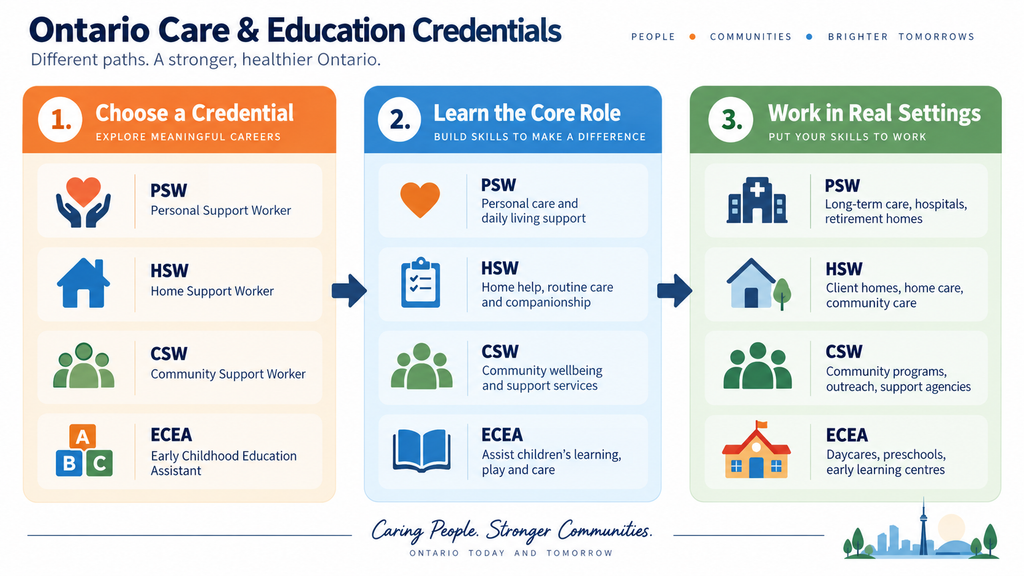
A personal support worker (PSW) provides hands-on personal care, including bathing, dressing, and mobility support, across hospitals, long term care facilities, and private homes. A home support worker (HSW) delivers similar but lighter, non-medical support, usually limited to private homes rather than institutional care settings.
A community support worker (CSW) helps clients, often people with disabilities or chronically ill adults, participate in community organizations and community settings rather than a clinical or in-home setting alone. An early childhood education assistant (ECEA) supports a registered early childhood educator inside a licensed child care setting, working with children rather than adults. All four sit outside university-level education, typically completed through Ontario colleges in under a year.
How it works
Each of these four paths follows a similar mechanism: classroom coursework covering the specific population served, paired with a supervised practicum before graduation.
Step by step
Most programs across these four credentials follow the same three stages, regardless of which population they train students to support.
Stage one: classroom coursework
Students complete theoretical coursework covering the core skills for their chosen path: personal care procedures for PSW, household support and communication for HSW, community-based support planning for CSW, or child development for ECEA. Education and training typically include completing a recognized program approved by the province or the college itself.
Stage two: certifications and clearances
Before any placement begins, students complete CPR and First Aid certifications, both mandatory across all four credential types. A clear Vulnerable Sector Check is also required, since every one of these roles involves working directly with children, seniors, or other vulnerable populations. Required documentation typically includes proof of these clearances alongside standard immunization records.
Stage three: practicum or clinical placement
Students complete a supervised placement inside a real care facility, private home, or child care setting, applying classroom learning under the guidance of experienced professionals. Clinical placements occur in various settings across the Greater Toronto Area, and students may need to travel up to two hours to reach an assigned clinical agency, since placement availability depends on which sites currently have space for students that term.
The main types
The table below lines up all four credentials by full name, typical setting, and population served, since the acronyms alone rarely make the distinction obvious.

Type comparison table
| Credential | Full Name | Typical Setting | Population Served |
|---|---|---|---|
| PSW | Personal Support Worker | Hospitals, long term care, private homes | Elderly, chronically ill, patients recovering from illness |
| HSW | Home Support Worker | Private homes | Elderly or disabled clients needing light, non-medical support |
| CSW | Community Support Worker | Community organizations, group homes, day programs | Adults with disabilities or accessibility challenges |
| ECEA | Early Childhood Education Assistant | Licensed child care settings | Infants through school-age children |
Type one: the personal support worker (PSW)
A PSW program in Mississauga combines classroom study with a practicum component, typically totalling at least 9 weeks of hands-on placement before graduation. The PSW credential carries the broadest range of employment settings among the four, since graduates can work in private homes and nursing homes, hospices, hospitals, and long term care facilities.
Best suited to
A PSW path suits applicants who want the widest range of care facility employers to choose from after graduation, and who are comfortable with hands-on physical tasks like transfers, bathing, and mobility support across a full range of client needs. It also suits applicants who value consistent, close relationships with the same residents over time, since PSWs often provide continuity and reassurance through repeated daily contact rather than one-off interactions, forming genuine bonds with the people they support.
Limitation to know
PSW training does not include the clinical scope of a Registered Practical Nurse; some PSWs pursue further education toward an RPN credential later for expanded clinical responsibilities and higher pay. PSWs also cannot administer most medications directly, typically limited to reminding clients rather than dispensing.
Type two: the home support worker (HSW)
A home support worker provides non-medical support inside a client’s private home, focusing on companionship, meal preparation, and light housekeeping rather than hands-on clinical care.
HSW training is typically shorter and less formally structured than a PSW program, with many workers entering through short certificate courses or on-the-job training rather than a full college credential. Employers in private home care and some community agencies hire HSWs for clients who need practical daily support without the clinical scope a PSW provides.
Type three: the community support worker (CSW)
A community support worker helps clients, typically adults with physical or intellectual disabilities, access and participate in community organizations, group homes, and day programs.
CSW training usually involves a certificate or diploma focused on disability support, community services, and client rights, rather than personal care techniques. This role is more relationship and coordination focused than the PSW or HSW, centering on helping clients build and maintain independence in daily community life rather than providing hands-on care in a home or facility setting.
Type four: the early childhood education assistant (ECEA)
An ECEA supports a registered early childhood educator inside a licensed classroom, helping deliver early childhood education to infants through school-age children. Daily tasks include supervising play, assisting with meals and rest routines, and supporting a lead educator’s planned activities rather than designing curriculum independently.
Unlike the other three credentials, this path can lead toward eligibility for registration with Ontario’s College of Early Childhood Educators after further study, formalizing the role into a fully registered early childhood educator position.
Many students choose the ECEA route first specifically because it offers paid, hands-on experience working with children before committing to the longer diploma program required for full RECE registration. This staged approach also lets students confirm they genuinely enjoy classroom-based work with children before investing in a multi-year credential.
What it is not
These four credentials are often confused with each other, and with a handful of adjacent roles, so a few clarifications matter here.
PSW is not the same as HSW, even though job postings sometimes use the terms loosely; a PSW’s training and scope of practice run deeper, particularly around clinical-adjacent tasks like monitoring changes in a client’s physical and mental health conditions.
PSWs form the primary communication link between residents, families, and the healthcare team in many long term care settings, a responsibility that goes beyond an HSW’s typical scope. For a full side-by-side comparison, see are HSW and PSW the same and the broader HSW vs PSW guide, both of which break down day-to-day duties in more depth than this overview covers.
None of these four credentials should be confused with a Registered Nurse or Registered Practical Nurse, both of which require separate, longer, regulated education and provincial licensing through the College of Nurses of Ontario.
Some PSWs pursue further education to become Registered Practical Nurses later in their career, using the PSW role as a practical, paid stepping stone rather than starting nursing school with no hands-on care experience at all. This progression is common enough that some Ontario colleges structure bridging pathways specifically for PSW graduates moving toward RPN study, recognizing prior coursework rather than starting from zero.
A CSW should also not be confused with a registered social worker, which requires a full degree and separate provincial registration; a CSW provides practical, day-to-day support rather than clinical or therapeutic counselling.
CSWs typically work inside community organizations, helping clients with accessibility challenges build independence in daily life, a distinct focus from a social worker’s more clinical case management role. The two roles often collaborate on the same case, with a social worker handling formal assessments and a CSW handling the practical, ongoing support that follows.
Finally, an ECEA is not the same as a registered early childhood educator (RECE); the ECEA supports an RECE’s classroom rather than leading one independently, and does not carry the same regulatory registration or legal scope of responsibility.
Understanding this distinction matters most for applicants who assume any early childhood education work automatically requires full RECE registration, when in practice many entry-level roles do not. An ECEA still plays a vital role in a classroom’s daily operation, even without carrying the same legal accountability as the lead RECE, and this hands-on experience often makes the eventual transition to full RECE study noticeably smoother.
Who it suits in Ontario
Mississauga has a significant network of long-term care and seniors’ care facilities, driving consistent local demand for PSW and HSW graduates specifically.
Ontario’s aging population continues to push demand for all four of these credentials upward, though PSW roles currently show the widest range of open positions across hospitals, long term care, and home care combined. Employers in the region consistently report difficulty filling PSW positions fast enough to meet demand, which keeps job prospects strong for new graduates entering the field.
Central College of Business & Technology offers a PSW program in Mississauga built around this exact local demand, combining classroom coursework with supervised clinical placement experience. The program suits both recent graduates and mature students, including career changers looking for a faster path into a vital healthcare-adjacent role than a full nursing degree requires.
Pay is a common early question for applicants weighing these paths against each other.
For a full breakdown of realistic earnings, see how much does a PSW make in Ontario for providing holistic health care, which covers wage ranges across different care settings. Applicants weighing the exact difference between PSW and HSW training before applying can also review how much does the PSW course cost in Ontario as part of that comparison.
For applicants specifically weighing CSW or ECEA against a PSW path, the deciding factor usually comes down to preferred population and setting rather than pay alone. Someone drawn to working with children will rarely feel satisfied in a PSW role focused entirely on elderly or chronically ill adults, regardless of how strong local PSW job prospects look on paper.
The same logic applies in reverse.
A candidate who feels most fulfilled providing hands-on physical care and building long-term relationships with the same residents over months or years will likely find a CSW’s more varied, community-based caseload less satisfying than the consistency a PSW role in long term care can offer. Taking time to genuinely reflect on which setting and population feels right, rather than defaulting to whichever credential has the shortest program length, tends to produce better long-term career satisfaction and a more lasting impact across all four of these care and education paths.
Frequently asked questions
What is the difference between a PSW and an HSW?
A personal support worker (PSW) completes formal college training and provides hands-on personal care, including bathing and mobility support, across hospitals, long term care, and private homes.
A home support worker (HSW) offers lighter, non-medical support, usually limited to private homes, with shorter and less formal training than a PSW program requires before graduates can start working with clients. Job postings sometimes blur this line, so confirming exact duties before accepting a role helps avoid confusion later.
How long does a PSW program take to complete?
A personal support worker program typically runs close to 27 weeks, combining classroom coursework with at least 9 weeks of practical placement in a real care setting. Exact length varies by Ontario college and whether a student studies full-time or part-time, but most programs complete within a single academic year, including all required clinical hours and documentation.
What is a CSW and how is it different from a PSW?
A community support worker (CSW) helps clients, often adults with disabilities or accessibility challenges, participate in community organizations and community settings like day programs or group homes. A PSW focuses more on direct personal care in homes, hospitals, and long term care facilities, making the two credentials complementary but distinct in scope, setting, and the specific populations each typically serves day to day.
Can an ECEA become a fully registered early childhood educator later?
Yes.
An early childhood education assistant (ECEA) can pursue further study toward becoming a registered early childhood educator (RECE), which requires a full early childhood education diploma and registration with Ontario’s College of Early Childhood Educators. Many ECEAs use the assistant role as a practical, paid starting point before committing to the longer credential and its added coursework and practicum requirements.
About Central College of Business & Technology
Central College of Business & Technology is a registered private career college located in Mississauga, Ontario, at 1140 Burnhamthorpe Rd W, Unit 201, specialising in personal support worker alongside business, technology, and healthcare programs. The college offers a personal support worker program alongside early childhood education, business, and technology programs, combining classroom instruction with supervised practical experience across every credential path.
Enquiries: +1 905-566-0507 | info@central-college.ca
Programs are built around current employer expectations across Ontario colleges and the local care sector, with instructors who bring direct field experience into the classroom. Small class sizes let instructors give individualized feedback on hands-on skills like transfers, personal care technique, and client communication before students begin their clinical placement, reducing the learning curve once real placement hours start.
The college also supports students through the application process itself, from gathering required documentation like a Vulnerable Sector Check to confirming eligibility before enrollment begins. This support matters most for mature students returning to education after time away from formal coursework, since navigating paperwork and prerequisites alone can otherwise delay a start date by weeks.
Service area
Central College serves students across the Greater Toronto Area, including Mississauga, Brampton, Oakville, Etobicoke, and Toronto, placing graduates within reach of the region’s hospitals, long term care facilities, and community organizations.
This regional coverage matters directly for placement quality, since students need reasonable access to a range of clinical agencies during their practicum.
A wider service area also means graduates have more potential employers to approach directly once they complete their program and required documentation, without needing to relocate away from family or existing part-time work to find their first placement or job offer. Students commuting from Brampton or Oakville, in particular, benefit from Central College’s central Mississauga location when scheduling both classes and placement shifts around existing commitments.
Next step
If you’re ready to explore a career supporting seniors, patients, or families, review the PSW program in Mississauga at Central College of Business & Technology for admission requirements, program length, and placement details, or reach out to speak with an advisor about how this credential compares to the other three paths covered in this guide.