
CBAP certification is the Certified Business Analysis Professional designation, awarded by the International Institute of Business Analysis (IIBA) to senior business analysts who meet strict experience and education thresholds.
In Ontario and globally, it signals the highest tier of the IIBA’s three-level system for business analysis professional CBAP credentialing.
This guide explains what the credential requires, how it compares to ECBA and CCBA, and who in Canada should pursue it and when.
Key takeaways
CBAP is a career-defining credential for experienced business analysis professionals, not a certification candidates earn early and carry into their career. Five facts shape the decision most accurately.
- CBAP requires 7,500 hours of documented business analysis experience, at least 900 of which must fall in each of four of the six BABOK Guide knowledge areas.
- The IIBA application fee for CBAP is US$145, with exam fees of US$350 for IIBA members and US$505 for non-members.
- CBAP certification increases salary by 13 percent on average according to IIBA survey data, with many holders reporting salary growth within a year.
- The CBAP exam covers 120 multiple-choice questions across 210 minutes, drawn from the six core BABOK Guide knowledge areas.
- The IIBA has over 30,000 members worldwide, making CBAP recognition genuinely global rather than limited to North American employers.
These five figures explain why the certification attracts experienced professionals who are ready to formalize their expertise rather than early-career analysts looking for a credential that opens the first job.
What the CBAP Certification Is
The Certified Business Analysis Professional (CBAP) is a senior-level professional certification offered by the International Institute of Business Analysis, a non-profit professional association headquartered in Canada.
It validates extensive business analysis experience rather than foundational knowledge alone, requiring candidates to demonstrate 7,500 documented hours of business analysis work across multiple projects before they can even apply.
The CBAP exam then tests deep familiarity with all six knowledge areas in the BABOK Guide, the business analysis body of knowledge published by the IIBA, including requirements elicitation, requirements analysis, solution evaluation, and stakeholder management, to ensure certified professionals can lead and mentor, not just execute.
Unlike entry or mid-level certifications in the same family, CBAP signals that a candidate has already spent years applying the IIBA’s business analysis practices in real organizational contexts, not just studied them in preparation for an exam.
This is why most senior BA job postings treat CBAP as a differentiator rather than a baseline, and why IIBA survey data consistently points to a 13 percent average salary increase for certified professionals, per the IIBA 2025 Global State of Business Analysis Report.
How it works
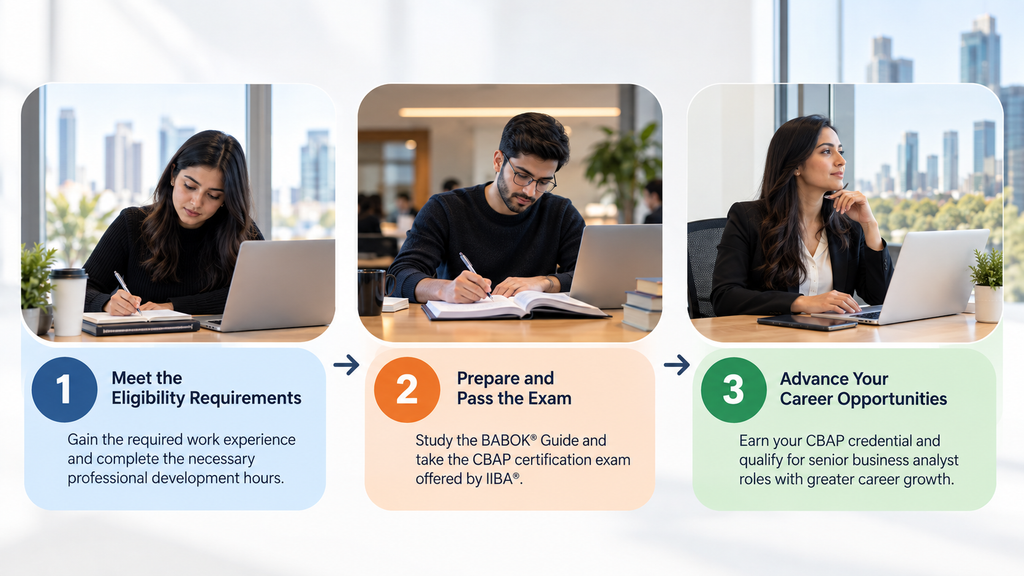
The CBAP certification path is sequential: meet the eligibility thresholds, submit an auditable application, then pass the exam. No part of this process can be bypassed.
Step by step
The path from eligible candidate to CBAP certified professional covers three stages before and after the exam itself.
Stage one: confirm eligibility
Candidates must accumulate 7,500 hours of business analysis experience within the last ten years, with at least 900 hours logged in each of four of the six core BABOK Guide knowledge areas.
This experience must align with tasks the IIBA recognizes as business analysis work, which includes requirements elicitation, analysis and design definition, requirements management, business process modeling, and stakeholder engagement.
Completing general project coordination or operations management work does not typically qualify, even if significant in scope, since the IIBA evaluates whether a candidate’s documented hours reflect actual business analysis practice rather than adjacent responsibilities.
Candidates must also complete 35 hours of professional development training within the four years preceding application.
This professional development must relate directly to business analysis, not general management or project management training alone.
Two professional references who have known the candidate professionally for at least six months are required before submitting the application, and both references must be able to speak to the candidate’s business analysis work specifically rather than their general professional conduct.
Many experienced business analysts are surprised to discover that the eligibility stage takes longer than the exam preparation itself.
Logging, categorizing, and verifying 7,500 hours across multiple projects and employers requires careful documentation, and candidates who start this process only after deciding to pursue the certification often need several additional months before they can submit.
Starting to track hours deliberately, project by project, well before applying saves significant time later in the process.
Stage two: apply and pay
Candidates submit their application and pay the US$145 non-refundable application fee before the IIBA reviews eligibility. A random audit process may require candidates to provide supporting documentation, such as signed letters from employers, during this stage.
Once approved, candidates pay the exam fee: US$350 for IIBA members or US$505 for non-members.
Candidates interested in structured preparation before this stage can review Central College’s CBAP exam prep workshop for what a focused prep course covers. Candidates must also agree to the IIBA Code of Ethical Conduct before their application is accepted.
Stage three: pass the exam
The CBAP exam consists of 120 multiple-choice questions to be completed within 210 minutes.
It can be taken online from home or at a PSI test centre, and draws entirely from the BABOK Guide’s six knowledge areas.
Most candidates report that the experience requirement is harder to satisfy than the exam itself, since knowledge required comes directly from work candidates have already spent years doing.
The exam does not simply test factual recall of the BABOK Guide.
It presents scenario-based questions that ask candidates to apply business analysis planning, stakeholder requirements analysis, and effective business analysis judgment to real situations, choosing the most appropriate response rather than the technically correct one.
This distinction means candidates who have relied solely on memorizing the guide often struggle more than those who have practiced applying its frameworks to simulated project scenarios.
Passing completes the certification, which remains valid for three years before renewal through continuing education.
The main types
The IIBA offers three core certification levels, each targeting a different career stage.
Understanding where CBAP sits relative to ECBA and CCBA helps candidates decide whether to pursue it now or build toward it first. For a complete breakdown of all three levels, see ECBA certification, CCBA certification, CBAP certification.

Type comparison table
| Certification | Experience Required | Professional Development | Application Fee | Who It Targets |
|---|---|---|---|---|
| ECBA | None | 21 hours | Included in exam fee | Career starters |
| CCBA | 3,750 hours | 21 hours | US$145 | Mid-career BAs |
| CBAP | 7,500 hours | 35 hours | US$145 | Senior BAs and leads |
Type one: CBAP — the senior credential
CBAP is the highest of the three core IIBA certifications and the only one that explicitly validates senior-level, extensive business analysis experience across multiple knowledge areas simultaneously.
Most senior BA job postings in finance, healthcare, and technology explicitly prefer or require CBAP certification.
A CBAP holder demonstrates mastery of the full business analysis lifecycle, from initial business analysis planning through final solution evaluation, in a way that neither ECBA nor CCBA requires.
Preparing for the CBAP exam also deepens knowledge of business analysis practices and strategic thinking beyond what most candidates bring from experience alone.
Many certified professionals report that the preparation process itself produced a measurable improvement in how they approached stakeholder engagement, requirements management, and risk mitigation on real projects, not just on the exam.
CBAP holders also face lower unemployment rates than non-certified peers, which reflects both the credential’s market value and the experience threshold required to earn it.
Best suited to
CBAP suits business analysis professionals with seven to ten or more years of project-level experience who are ready to move into senior analyst, BA lead, or program-level roles and need a credential that signals that readiness to employers, project managers, and business stakeholders without requiring explanation.
Limitation to know
The 7,500-hour experience threshold makes CBAP inaccessible to candidates who have not yet spent several years in a dedicated business analyst role, regardless of academic background or general project management exposure.
Type two: CCBA — the step before CBAP
The CCBA, or Certification of Capability in Business Analysis, requires 3,750 hours of documented business analysis experience and serves as the standard next step for analysts who are not yet CBAP-eligible.
It uses the same BABOK Guide as the CBAP exam, testing at a mid-career depth rather than the senior level.
Candidates who have passed the CCBA certification exam preparation workshop often use that preparation directly when they later start CBAP study, since both exams draw from the same BABOK Guide knowledge areas and the CCBA preparation naturally builds toward CBAP-level depth.
For many Ontario business analysts, the CCBA serves a dual purpose: it is a credential worth holding independently at the mid-career stage, and it is also the clearest path toward the experience documentation habits that CBAP will eventually require.
Analysts who start tracking their BABOK-aligned hours during CCBA preparation arrive at the CBAP eligibility threshold with far more organized records than those who begin the documentation process only when they feel ready to apply for the senior certification.
Type three: ECBA — the entry point
The ECBA, or Entry Certificate in Business Analysis, is the starting credential for professionals new to business analysis.
It requires no prior business analysis experience and only 21 hours of professional development training, making it accessible to anyone exploring the field or transitioning from a related role in project management, operations, or data analysis.
The ECBA exam consists of 50 multiple-choice questions to be completed in one hour, drawing from the same BABOK Guide used by CCBA and CBAP but at a foundational depth.
Most candidates who later pursue CBAP begin with ECBA to establish their knowledge base before their documented hours qualify them for the higher tiers. Central College’s ECBA certification exam preparation workshop is designed for this entry stage.
What it is not
Three things CBAP is frequently confused with are worth clarifying before a candidate invests time in the application.
CBAP is not the same as the PMP (Project Management Professional) certification offered by the Project Management Institute. A PMP validates project management skills, particularly around project lifecycle management, budget control, and team leadership.
A CBAP validates business analysis knowledge, specifically the ability to define, document, and validate business requirements and proposed solutions from a business perspective, not a delivery or scheduling one.
Some professionals hold both credentials, and the two certifications complement each other well on a senior BA or program analyst’s resume, but they test distinct skill sets and signal different kinds of expertise to hiring managers.
A project manager who has also completed CBAP typically finds opportunities in business analysis practitioner roles and hybrid program leadership positions that neither credential alone would unlock as cleanly.
CBAP is also not a general professional certification in business or management. It is specific to the business analysis profession as the IIBA defines it, rooted in the BABOK Guide and the business analysis community’s shared professional standards.
A candidate whose experience sits primarily in operations management, data analysis without requirements work, or general project coordination may struggle to log the required BABOK-aligned hours even if their total career experience exceeds 7,500 hours by a significant margin.
The IIBA’s audit process checks whether hours were spent on recognized business analysis tasks, not simply whether a candidate has worked in a business environment for a long time.
Finally, CBAP is not the same as a nationally specific vocational certificate or employer-issued badge.
It is globally recognized and issued by an international non-profit professional association, which separates it from country-specific credentials. This global recognition matters for Ontario’s large population of internationally trained professionals and for those planning cross-border career moves.
Career growth and job prospects for CBAP-certified professionals
CBAP’s impact on career advancement goes beyond a percentage salary lift.
In Canada’s financial and technology corridors, the certification functions as a filtering mechanism: many organizations that run enterprise-scale business analysis work use CBAP as a baseline filter for senior postings, meaning uncertified candidates with equivalent experience may not even appear in shortlists for those roles regardless of how strong their resume is.
Career growth into program-level business analysis, business architecture, and enterprise analysis all benefit from CBAP more than from general management credentials.
These roles typically require someone who can engage stakeholders across multiple departments simultaneously, manage competing requirements from business and technical teams, and evaluate proposed solutions against strategic business needs rather than just tactical project requirements.
The CBAP’s eligibility requirements map almost directly to the tasks these roles demand, which is part of why certified professionals report both faster advancement and higher retention offers after earning it.
Job prospects also strengthen in sectors where regulated documentation is mandatory.
In Ontario’s healthcare and financial services sectors in particular, the ability to produce auditable requirements documents and structured stakeholder engagement records matters for compliance as much as for project quality.
CBAP-certified professionals demonstrate, through both their documented experience and their exam results, that they can produce and defend this kind of work under scrutiny, which is a significant differentiator in regulated industries.
For business analysis professionals weighing CBAP against other senior credentials, the global recognition that comes with a CBAP is a meaningful advantage in a job market where many employers have distributed teams across time zones.
A CBAP holder applying to a Toronto-based organization with US or UK stakeholders carries a credential recognizable to hiring managers in all three markets, which a nationally specific alternative typically does not.
Ontario’s financial services, healthcare technology, and government consulting sectors all show consistent demand for CBAP-certified business analysts, since these environments run complex, multi-year projects that require someone who can independently own the analysis and design definition workstream from the start.
In financial services specifically, business analysis professionals who hold CBAP certification regularly lead requirements work on regulatory compliance projects, trading system upgrades, and digital transformation initiatives, where the cost of poorly defined requirements can run into millions of dollars.
Healthcare technology is another area where CBAP is increasingly expected rather than simply preferred.
As Ontario’s health system continues investing in electronic health records, patient data integration, and clinical decision support tools, organizations implementing these systems need senior analysts who can engage stakeholders from clinical, administrative, and technical teams simultaneously, all of whom define “requirements” in very different ways.
CBAP certification signals that a professional has navigated exactly this kind of complex stakeholder environment at scale before.
Government and public sector consulting firms also list CBAP in postings for senior roles, particularly for work involving large enterprise system implementations.
These projects often span multiple departments, have long timelines, and require detailed documentation that holds up to internal audit, all of which align directly with what the CBAP’s eligibility requirements and exam content test for.
The credential is also an internationally recognized one that supports career moves within Canada and abroad, which matters for Ontario’s large population of internationally trained business analysis professionals who want a credential that travels with them.
Professionals who have completed business analysis courses or work in the IIBA’s global ba community will find CBAP more readily recognizable to employers in the US, UK, Australia, and elsewhere than a locally issued certificate would be.
Central College of Business & Technology in Mississauga runs a CBAP exam prep workshop targeting business analysis professionals who have already met the experience threshold and want structured exam preparation rather than self-study alone.
The workshop covers all six BABOK Guide knowledge areas tested on the exam, with scenario-based practice questions drawn from real senior-level BA situations.
Candidates interested in starting earlier in the IIBA certification path can begin with the ECBA certification exam preparation workshop and build their hours before applying for CBAP.
Frequently asked questions
The four questions below reflect what Ontario professionals search most often when researching the CBAP, covering eligibility, cost, comparison with CCBA, and the practical salary impact most candidates want to understand before committing to the process.
What is the CBAP certification and who is it for?
CBAP certification is the Certified Business Analysis Professional designation from the IIBA, targeting experienced senior business analysts with at least 7,500 hours of documented BA work.
It validates the ability to lead requirements analysis, stakeholder management, and solution evaluation across complex projects. It is not an entry-level credential; most successful candidates have been working as dedicated business analysts for seven to ten years before applying.
How much does the CBAP exam cost?
The CBAP certification application fee is US$145 for all candidates, non-refundable. The exam fee is US$350 for IIBA members and US$505 for non-members.
Joining IIBA before applying typically costs US$65 to US$155 depending on country, making membership financially worthwhile for most candidates since the exam-fee discount exceeds the membership cost in most regions.
Total cost from application through exam typically runs US$495 to US$650 before any training costs.
What is the difference between CBAP and CCBA?
CBAP requires 7,500 hours of business analysis experience and targets senior analysts and leads, while CCBA requires 3,750 hours and targets mid-career professionals.
Both exams draw from the BABOK Guide, but CBAP tests a broader, deeper application of all six knowledge areas.
Most candidates pursue CCBA first, then build toward CBAP once they meet the higher experience threshold and have practiced tracking their hours against the IIBA’s knowledge area categories.
Does CBAP certification actually increase salary?
Yes.
IIBA survey data shows CBAP certification increases salary by 13 percent on average, with 81 percent of respondents in IIBA’s 2025 Global State of Business Analysis Report reporting benefits like salary growth within a year of certification.
Senior business analyst roles that explicitly require CBAP also tend to offer higher base salaries than equivalent roles that list it as preferred rather than required, and CBAP holders face lower unemployment rates than non-certified peers.
About Central College of Business & Technology
Central College of Business & Technology is a registered private career college located in Mississauga, Ontario, at 1140 Burnhamthorpe Rd W, Unit 201, specialising in CBAP and IIBA certification alongside business, technology, and healthcare programs.
The college runs IIBA-aligned exam preparation workshops for all three core certification levels, including a CBAP exam prep workshop for professionals ready to sit the senior exam. Enquiries: +1 905-566-0507 | info@central-college.ca
Programs are built around current BABOK Guide knowledge areas and real exam formats, with instructors who bring direct business analysis experience into every session, including exposure to the kinds of scenario-based questions the CBAP exam uses to test applied judgment rather than simple recall.
Workshop participants include experienced business analysts across Ontario from financial services, healthcare, government, and technology sectors.
Many attend after completing the CCBA or after several years of business analysis work, and Central College’s small class sizes allow instructors to tailor scenario discussions to the industries participants already work in, which reinforces how BABOK Guide frameworks apply in each candidate’s specific context rather than in generic examples alone.
Service area
Central College serves students across the Greater Toronto Area, including Mississauga, Brampton, Oakville, Etobicoke, and Toronto, with both in-person and online workshop access available for working professionals.
Next step
Ready to start preparing for the senior exam? Review the CBAP exam prep workshop at Central College of Business & Technology for schedules, format, and what is included before enrolling.