CAPM suits beginners, while PMP targets professionals with substantial project leadership experience. This guide compares CAPM and PMP, covering eligibility, exam requirements, career value, training options, and which certification suits different career stages. It helps aspiring and experienced project professionals choose the certification that best matches their experience, skills, and career goals.
Key Takeaways
- CAPM is an entry-level project management certification from PMI.
- PMP is designed for professionals with project leadership experience.
- CAPM requires a secondary degree and 23 hours of project management education.
- Current PMP eligibility depends on education, experience, and training.
- CAPM has a 150-question, three-hour examination.
- The current PMP examination contains 180 questions and lasts 240 minutes.
- Both certifications cover modern project management approaches.
- CAPM can be a practical starting point for students and career changers.
- PMP is better suited to experienced project practitioners.
- Certification should complement practical project management experience.
What Is CAPM?
CAPM stands for Certified Associate in Project Management. It is offered by the Project Management Institute, commonly known as PMI.
The certification validates foundational project management knowledge. It covers project management fundamentals, predictive approaches, agile frameworks, and business analysis.
PMI describes CAPM as a certification for people beginning their project management careers. It can also suit students, team members, and professionals transitioning into project management. (Project Management Institute)
The credential therefore provides a structured introduction to the profession.
What Is PMP?
PMP stands for Project Management Professional. It is also offered by the Project Management Institute PMI.
PMP validates professional project leadership experience and knowledge. It is intended for practitioners who have already led projects in professional settings.
The certification assesses the ability to work across people, processes, and business priorities. PMI positions PMP as a globally recognized professional credential. (Project Management Institute)
That distinction is central to the CAPM vs PMP decision.
CAPM vs PMP: The Main Difference
The biggest difference is experience.
CAPM is designed for people building foundational project management knowledge. You do not need prior project leadership experience to qualify.
PMP requires documented project leadership experience. The current requirements vary according to your educational background.
This means CAPM can be the logical starting point for beginners. PMP becomes more relevant after you have accumulated professional project experience.
CAPM Certification Requirements
The current CAPM certification requirements are straightforward. Candidates need a secondary degree or global equivalent.
They must also complete at least 23 hours of project management education before taking the examination. PMI accepts its own preparation course and eligible instructor-led education. (Project Management Institute)
No prior project management experience is required.
This makes CAPM accessible to students, recent graduates, professionals changing careers, and people already working on project teams.
PMP Certification Requirements
The current PMP certification has several eligibility pathways. Requirements depend on your education level and professional project leadership experience.
For applicants with a bachelor’s degree or equivalent, PMI’s current 2026 requirements include 36 months of non-overlapping project leadership experience within the past 10 years.
Applicants with a secondary education credential generally need 60 months of qualifying project leadership experience. PMI also provides pathways for certain post-secondary qualifications and PMI-accredited programs. (Project Management Institute)
Candidates also need the required project management training.
Has PMP Eligibility Changed?
Yes. PMI updated the PMP examination and eligibility framework in 2026.
The new PMP exam launched in July 2026. The updated examination reflects modern project environments and includes stronger emphasis on business and strategic considerations. (Project Management Institute)
This matters when researching older project management courses.
Some online articles still describe previous PMP requirements. Candidates should always check current PMI information before applying.
CAPM Exam Format
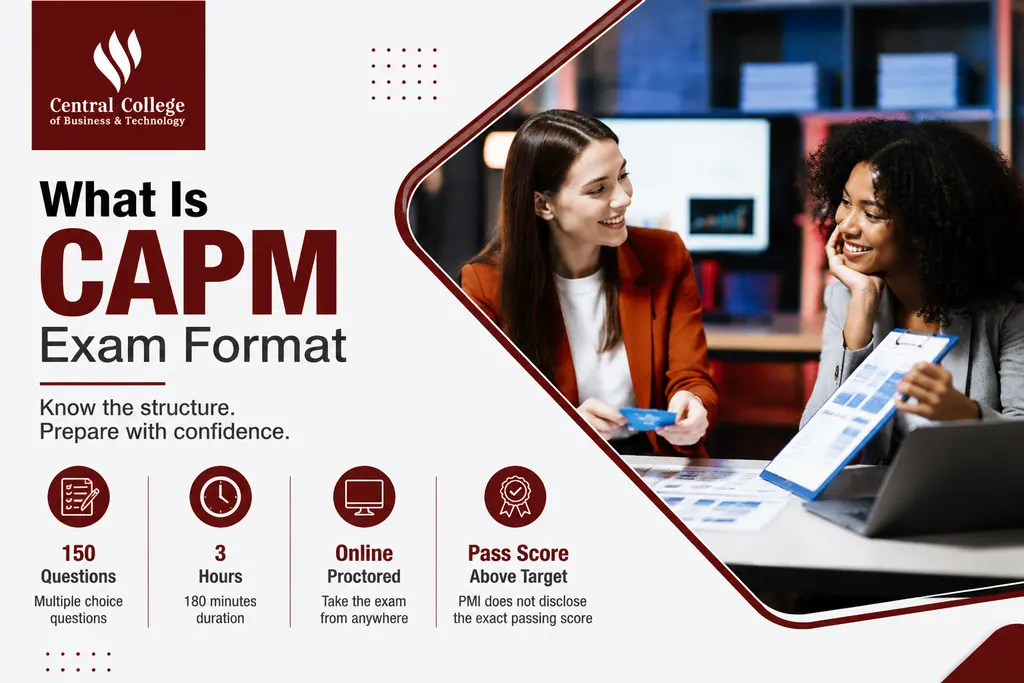
The CAPM exam contains 150 questions. Candidates receive 180 minutes to complete it.
The current exam covers four areas:
- Project management fundamentals and core concepts
- Predictive, plan-based methodologies
- Agile frameworks and methodologies
- Business analysis frameworks
PMI currently lists these areas as part of the CAPM examination content. (Project Management Institute)
The exam therefore tests more than traditional project management terminology.
PMP Exam Format
The current PMP examination contains 180 questions. Candidates receive 240 minutes.
The updated examination focuses on three domains:
- People
- Process
- Business environment
PMI’s 2026 exam changes also increase emphasis on leadership, technical skills, strategic thinking, and adaptive project environments. (Project Management Institute)
The exam is therefore aimed at experienced project practitioners.
What Does CAPM Test?
CAPM tests foundational knowledge. Candidates need to understand terminology, concepts, methods, and project management principles.
The certification also includes agile and business analysis content. This reflects the wider range of approaches used in modern projects.
The goal is not simply to memorize a project management body of knowledge. Candidates should understand how concepts apply to project situations.
What Does PMP Test?
PMP evaluates professional project leadership. The current exam covers people, processes, and business environment considerations.
The examination expects candidates to apply knowledge to realistic project situations.
This distinction matters. CAPM primarily demonstrates foundational knowledge. PMP demonstrates knowledge alongside professional project leadership experience.
CAPM vs PMP: Experience Requirements
Experience is the clearest dividing line.
CAPM does not require previous project management experience. You can qualify through education.
PMP requires documented experience leading projects. The amount depends on your educational pathway.
This means students cannot simply substitute a project management certificate for the experience required by PMP.
Education can prepare you. Professional experience completes the eligibility picture.
Which Certification Is Better for Beginners?
CAPM is generally the better starting point for beginners.
Students can use it to learn project management concepts before entering the profession. Recent graduates can also use it to demonstrate structured knowledge.
It may also suit professionals moving from another field.
If you have no project leadership experience, PMP is usually not the immediate option. Build the required experience first.
Which Certification Is Better for Experienced Project Managers?
PMP is more appropriate for experienced project managers.
If you already lead projects, manage stakeholders, coordinate teams, and make project decisions, PMP can align better with your professional experience.
The credential also requires applicants to demonstrate that experience.
Experienced project practitioners should therefore evaluate PMP eligibility before choosing CAPM preparation.
CAPM vs PMP for Career Changers
Career changers often ask which certification they should choose first.
CAPM can provide a structured foundation when someone has limited project management experience. It can introduce project management topics and terminology in a recognized framework.
However, certification alone does not replace workplace experience.
Career changers should combine training with practical project work whenever possible.
CAPM vs PMP for College Students
College students can benefit from learning project management early.
Students working on group assignments already practice some project-related activities. They may define goals, assign responsibilities, manage deadlines, and coordinate resources.
A certificate program can formalize those skills.
CAPM may be particularly relevant when students want an entry-level credential before entering professional project teams.
What Project Management Skills Should You Learn?
Certification preparation should not become your entire learning strategy.
Develop practical project management skills alongside certification knowledge.
Important areas include:
- Project planning
- Scope management
- Scheduling
- Risk management
- Quality management
- Stakeholder communication
- Resource planning
- Cost management
- Team collaboration
- Information management
- Change management
- Leadership
These skills help professionals manage projects rather than simply pass examinations.
Learn to Manage Projects
Learning to manage projects requires practice.
Start with small projects. Define the objective, scope, timeline, resources, and stakeholders.
Then track progress and document changes.
Students can manage academic projects this way. Working professionals can apply the same principles to workplace initiatives.
Practical application makes project management knowledge easier to retain.
Understand Project Stakeholders
Project stakeholders can influence project success. They may include customers, sponsors, employees, suppliers, managers, regulators, or other affected groups.
Strong project practitioners identify stakeholders early.
They also understand different expectations and communication needs.
This is why communication remains an important part of both project management education and professional practice.
Learn Risk Management
Risk management helps project teams identify uncertainty before it creates major problems.
Learn how to identify risks, assess probability and impact, develop responses, and monitor changes.
Good risk management does not mean eliminating every risk.
It means understanding uncertainty and making informed decisions.
Understand Quality Management
Quality management focuses on whether project outputs meet defined requirements.
Project teams establish standards, monitor performance, and address issues.
PMI-aligned project management education commonly includes quality management among its core topics.
Understanding quality also supports continuous improvement.
Use Project Management Tools
Modern projects depend on technology.
Common project management tools can support scheduling, task management, communication, documentation, reporting, and resource planning.
However, tools do not replace project management knowledge.
A professional must understand why a tool is being used and what information it should provide.
Learn the principle first. Learn the software second.
Information Management Matters
Projects generate large amounts of information.
Teams need to store documents, track decisions, maintain schedules, and communicate updates.
Good information management reduces confusion and supports accountability.
It also helps project teams find the information they need.
Central College’s project management curriculum includes information management and technology tools within its program structure. (Central College)
Online Courses and Flexible Learning
Online courses can make project management education more accessible.
They can suit working professionals, students, and international learners balancing other responsibilities.
However, delivery mode matters.
Some learners benefit from live instruction and group work. Others prefer self-paced study.
Before enrolling, check the program overview, assessment structure, instructor support, and required courses.
What Is a Project Management Program?
A project management program can provide broader education than a short certificate.
Programs may cover planning, scheduling, risk, quality, communication, stakeholder management, leadership, and project controls.
Some also include practical projects or placements.
When comparing programs, look beyond the title. Review the curriculum and learning outcomes.
Continuing Education and Certification
Project management is not a one-time learning activity.
PMI requires certified professionals to maintain their credentials through continuing development.
PMP holders currently need 60 professional development units every three years. CAPM holders need 15 PDUs within each three-year cycle. (Project Management Institute)
This reflects the importance of continuous improvement.
Professionals need to keep their knowledge current as project practices change.
How Long Does Certification Preparation Take?
Preparation time varies by learner.
CAPM candidates need at least 23 hours of project management education. PMP candidates need the required project management training before applying, unless they qualify through an accepted alternative such as an active CAPM certification. (Project Management Institute)
Your total study time will depend on experience and familiarity with project concepts.
Do not choose a course solely because it promises a fast completion.
Can CAPM Lead to PMP?
Yes. CAPM can be part of a longer project management career path.
An active CAPM certification can satisfy the project management education requirement for PMP applications. It does not remove the professional experience requirement. (Project Management Institute)
This creates a logical progression for some professionals.
Start with foundational knowledge. Gain experience. Then pursue PMP when you meet the eligibility requirements.
CAPM vs PMP: Career Opportunities
Both credentials can support professional development.
CAPM can demonstrate foundational knowledge to employers seeking entry-level project support talent.
Potential roles can include project coordinator, project administrator, project analyst, or project team member.
PMP is more aligned with experienced professionals seeking project leadership responsibilities.
The credential does not guarantee a specific job title or salary.
Does Certification Increase Salary?
Certification can support career development, but salary should not be guaranteed.
Compensation varies by country, industry, experience, location, organization, and role.
PMI’s salary research has historically reported higher median salaries among PMP-certified respondents. However, certification and salary are not proof of direct causation. Experience and job level also matter. (Project Management Institute)
Students should therefore treat salary claims cautiously.
What About Project Management Job Growth?
Project management skills apply across industries.
Organizations use projects in technology, construction, healthcare, finance, manufacturing, government, education, and nonprofit work.
Demand can therefore vary by industry and region.
Instead of relying on a single growth percentage, examine current job postings in your target location. Look for recurring requirements involving project coordination, stakeholder management, risk, scheduling, and reporting.
Choosing Between CAPM and PMP
Use your current situation as the starting point.
Choose CAPM if:
- You are new to project management.
- You are a recent graduate.
- You have limited project leadership experience.
- You want foundational project management knowledge.
- You are changing careers.
- You want an entry-level certification.
Choose PMP if:
- You already lead professional projects.
- You meet PMI’s experience requirements.
- You want to strengthen your project leadership credentials.
- You manage complex projects or teams.
- You are pursuing more senior project responsibilities.
This comparison makes the decision simpler.
What Should International Students Consider?
International students should separate education decisions from certification decisions.
First, check whether the program meets your academic and career objectives.
Then review certification requirements separately.
Do not assume that completing a Canadian project management program automatically makes you eligible for PMP.
PMI eligibility is based on its own requirements.
Students should also verify immigration and employment rules independently.
What Should Working Professionals Consider?
Working professionals should evaluate their existing experience.
If you already lead projects, PMP may be more relevant.
If you support projects without leading them, CAPM may provide useful foundational knowledge.
Consider your career goals and current responsibilities.
The best certification is the one that matches your professional stage.
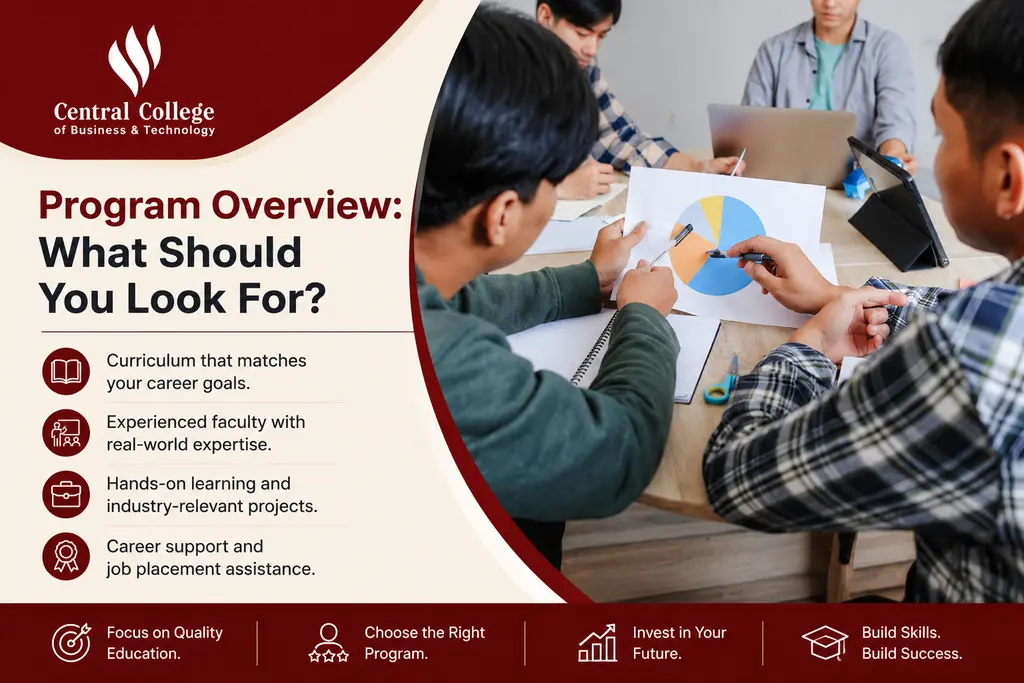
Program Overview: What Should You Look For?
A strong program overview should explain the curriculum clearly.
Look for project planning, risk management, quality management, stakeholder engagement, communication, information management, and practical application.
Also examine the delivery mode.
Does the program offer online, classroom, or blended learning?
Are assignments individual or collaborative?
Does the curriculum include practical projects?
These questions help you compare programs properly.
Why Choose Central College of Business & Technology?
Central College of Business & Technology in Mississauga offers a Post-Graduate Diploma in Project Management. Its current program is listed as one academic year with 680 total hours. This includes 620 theory hours and a 60-hour capstone project. (Central College)
The published curriculum is based on PMI’s PMBOK Guide and Agile Practice Guide. Central College states that students develop project management knowledge and apply their skills to real-world projects.
The program also includes practical learning. Central College currently describes 125 hours of hands-on practice and field placement experience within its program information. (Central College)
The program can therefore provide a structured learning route for students building project management knowledge.
CAPM vs PMP: Which Should You Start With?
If you are starting from scratch, CAPM is usually the more appropriate choice.
It has no professional project leadership requirement. It requires a secondary degree and 23 hours of project management education.
If you already have substantial project leadership experience, evaluate PMP eligibility.
The decision should reflect your experience, not simply which credential sounds more advanced.
How to Start Your Certification Journey
Begin by assessing your current experience.
Next, identify your career goals.
Then compare CAPM and PMP requirements.
Choose the certification that matches your current eligibility.
Build a study plan around the official examination content.
Finally, develop practical project management skills alongside certification preparation.
This approach creates a stronger foundation for a rewarding career.
FAQs
What is the main difference in CAPM vs PMP?
The biggest difference is professional experience. CAPM is an entry-level credential for people developing foundational project management knowledge. PMP is designed for professionals with documented project leadership experience. CAPM requires a secondary degree and 23 hours of education. PMP requires qualifying education and professional experience based on your educational pathway and current PMI requirements.
Can I get CAPM certification without project management experience?
Yes. CAPM certification does not require previous professional project management experience. PMI currently requires a secondary degree or equivalent and at least 23 hours of project management education. This makes CAPM suitable for students, recent graduates, career changers, and professionals who participate in project teams but have not yet accumulated the experience required for PMP.
Do I need PMP certification to manage projects?
No. PMP certification is not a universal requirement for managing projects. Organizations establish their own hiring and qualification requirements. Project managers can develop through education, practical experience, mentoring, and other credentials. PMP can demonstrate professional project leadership knowledge, but certification does not replace practical skills, communication, judgment, or experience.
Can online courses prepare me for CAPM or PMP?
Yes. Online courses can provide structured project management education and exam preparation. However, confirm that the course meets the current PMI education requirements. CAPM requires 23 hours of project management education. PMP requires the applicable training requirement before application. Always compare the course content with the current PMI examination information.
What should I check before choosing a project management certificate program?
Review the program overview, curriculum, instructors, delivery mode, practical learning, assessment methods, and certification alignment. Confirm the number of education hours and whether they meet current PMI requirements. Also check whether the program teaches risk management, quality management, stakeholder communication, information management, and project controls. Finally, review the institution’s current admission and program information.
Final Verdict: CAPM or PMP?
CAPM vs PMP is not really a competition between two certifications.
They serve different stages of a project management career.
CAPM is designed for people developing foundational knowledge. PMP is designed for professionals who already have substantial project leadership experience.
If you are starting your journey, CAPM can provide a structured foundation. If you already meet PMP’s experience requirements, PMP may better match your career stage.
Your certification should support practical project management skills. It should also align with your career goals, education, and experience.
For students and professionals in Mississauga, Central College’s Post-Graduate Diploma in Project Management provides structured training in project management concepts, practical application, and a capstone project. (Central College)
Before enrolling, review the current program information and PMI requirements. Then choose the credential that matches where you are today and where you want your career to go.