A graduate diploma in Canada can provide focused, practical training for students seeking career advancement. This guide explains the benefits, career value, program options, costs, and key considerations when pursuing a graduate diploma in Canada.
Key Takeaways
- Graduate diplomas offer focused, career-oriented education.
- Programs can help students develop practical skills for specific industries.
- Colleges and universities offer different types of graduate-level diplomas.
- Common areas include business, information technology, healthcare, engineering, and cybersecurity.
- Some programs include practical projects, placements, or co-op opportunities.
- PGWP eligibility depends on the institution, program, study permit application date, and field of study.
- A graduate diploma does not automatically qualify a graduate for permanent residency.
- Program selection should begin with your career goals, not immigration plans alone.
What Is a Graduate Diploma in Canada?
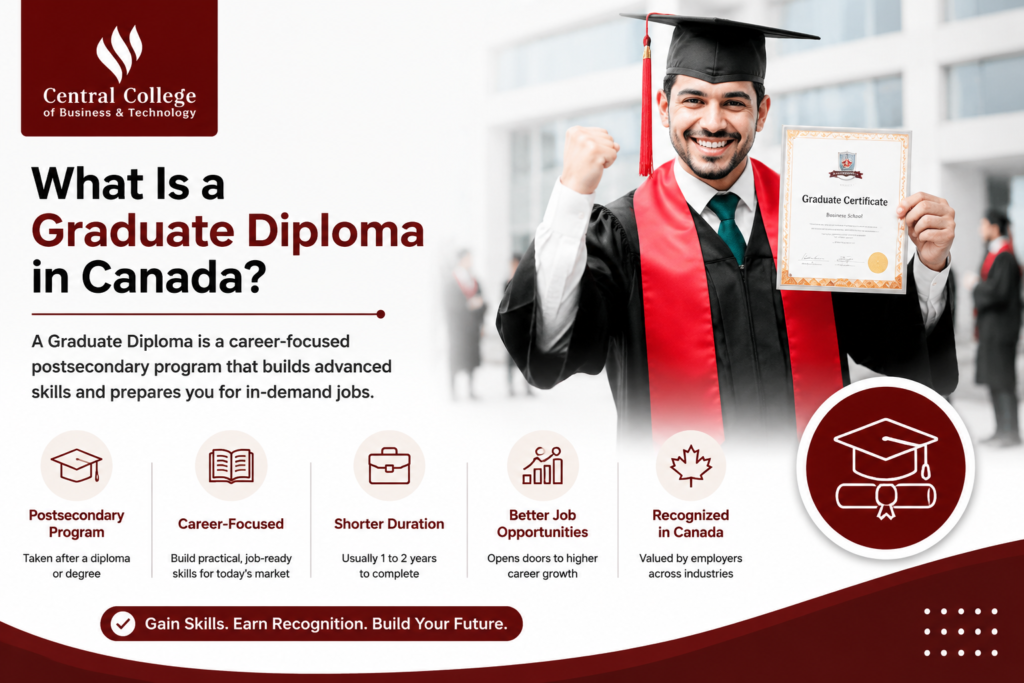
A graduate diploma in Canada is a post-secondary credential designed to provide specialized education beyond undergraduate studies. The exact structure varies between institutions.
Some graduate diplomas are designed for professionals seeking additional expertise. Others provide focused preparation for specific occupations or industries. Canadian universities and colleges use different terminology, so students should review the exact credential before applying.
A graduate diploma should not automatically be treated as equivalent to a master’s degree.
Graduate Diploma vs Bachelor’s Degree
A bachelor’s degree generally provides broader undergraduate education. A graduate diploma focuses on specialized knowledge after previous post-secondary education.
The difference is important when comparing programs. Students who need broad academic preparation may prefer a degree. Students who already have foundational education may prefer focused professional training.
Canadian colleges commonly emphasize applied and practical education. (EduCanada)
Graduate Diploma vs Master’s Degree
A graduate diploma is generally shorter and more focused than a master’s degree. It can therefore suit learners seeking specialized professional development without committing to a full graduate degree.
However, a graduate diploma does not provide the same academic level or credential as a master’s degree. Students planning research, doctoral studies, or advanced academic careers should compare graduate pathways carefully.
How Long Do Graduate Diplomas Take?
Program length varies significantly by institution and credential. Many career-focused graduate diploma programs can take several months to two years.
For example, Central College’s Post-Graduate Diploma in Project Management spans one academic year. Its published program includes 680 total hours and a capstone project. (Central College)
Always check the official program schedule rather than relying on a general duration.
Why Choose a Graduate Diploma?
The main advantage is specialization. A graduate diploma can help students develop skills in a defined subject area.
This focused approach can be useful when your bachelor’s degree provides general knowledge but your target role requires additional technical or professional abilities.
The right program should connect directly with your intended occupation and industry.
Practical Skills and Career-Focused Education
Canadian colleges often emphasize practical training for specific occupations. Programs can combine theoretical learning with applied assignments, projects, labs, or work-integrated learning. (Job Bank Canada)
This makes career-focused education attractive to learners seeking workplace skills.
However, practical training does not guarantee employment. Your results depend on your skills, experience, location, occupation, and the labour market.
Which Diploma Courses Are Popular?
The best diploma courses depend on your existing education and career objectives. Common subject areas include business, information technology, healthcare, engineering, finance, and project management.
Technology-focused programs may cover network administration, cybersecurity, artificial intelligence, or machine learning. Business programs can include business administration, leadership, finance, or project management.
Choose based on career relevance rather than popularity alone.

Business Administration
Business administration remains a broad field with applications across many industries. Graduate-level business programs can help learners strengthen management, communication, finance, operations, and leadership knowledge.
A specialized business diploma can also be useful for professionals seeking to move into management or administrative roles.
The curriculum should match the type of business position you want to pursue.
Information Technology and Cybersecurity
Information technology programs can help students develop technical skills for modern workplaces. Specialized areas include network administration, cloud systems, cybersecurity, and software-related technologies.
Central College offers a Post-Graduate Diploma in Network & Cloud Systems Engineering. Its published curriculum includes network infrastructure, VPNs, encryption, authentication, firewalls, security monitoring, and cloud systems. (Central College)
These skills can support technology-focused career paths.
Artificial Intelligence and Machine Learning
Artificial intelligence and machine learning are increasingly relevant across technology and business. Students should distinguish between learning AI concepts and preparing for specialized technical roles.
A strong program should explain its technical curriculum clearly. Look for subjects involving data, programming, models, analytics, or AI applications.
The right choice depends on your previous technical knowledge and desired career.
Healthcare and Other Fields
Healthcare remains another important area for post-secondary education. Students can find programs related to healthcare administration, support services, information systems, and other specialized areas.
Other graduate diploma subjects include engineering, business, finance, technology, and management.
When comparing options, examine the occupation associated with the program. This is particularly important for international students Canada.
Are Diploma Programs Practical?
Many diploma programs emphasize applied learning. Depending on the institution, this can include projects, practical assignments, labs, field placements, internships, or capstone work.
For example, Central College’s Project Management diploma includes a 60-hour capstone project within its published program structure. (Central College)
Practical components can help students apply classroom knowledge to realistic situations.
What About Co Op and Work Experience?
Some programs include co op, internships, or other work-integrated learning opportunities. These experiences can help students understand workplace expectations and apply their skills.
Not every diploma includes a placement. Students should confirm whether one is mandatory, optional, paid, unpaid, or included in the curriculum.
Do not assume a program provides Canadian work experience simply because it is career focused.
Can International Students Study a Graduate Diploma?
Yes, eligible international students can study at qualifying Canadian institutions. However, admission and immigration requirements depend on the institution, program, and student’s circumstances.
Students generally need a valid study permit when required. They should also confirm whether the specific institution and program meet current immigration requirements before applying. (Government of Canada)
Does a Graduate Diploma Qualify for PGWP?
This is one of the most important questions for international students.
A post graduation work permit is not automatic after completing a diploma. PGWP eligibility depends on several factors, including the institution, program, study permit application date, language requirements, and field of study. (Government of Canada)
For non-degree programs, students who applied for a study permit on or after November 1, 2024 generally need to graduate in an eligible field of study.
What Changed for PGWP Eligibility?
The rules changed on November 1, 2024. Students graduating from non-degree programs can face language and field-of-study requirements.
The eligible field list is connected to labour shortages and can change. The government currently publishes eligible Classification of Instructional Programs, or CIP codes. (Government of Canada)
Therefore, never select a diploma solely because someone claims it qualifies for a PGWP.
Can a Graduate Diploma Lead to Permanent Residency?
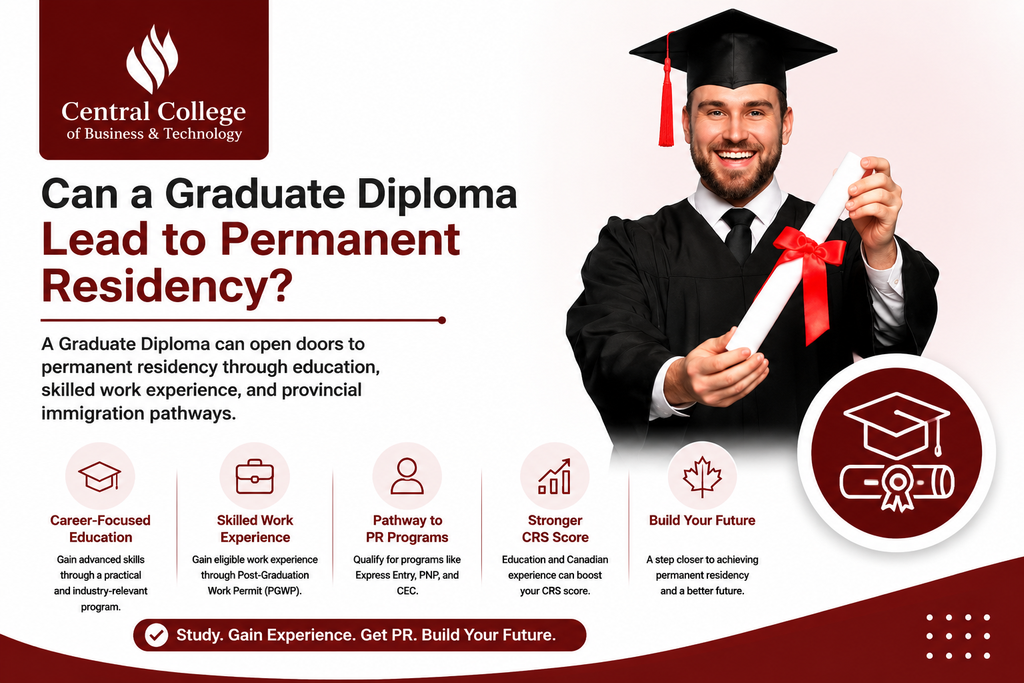
A graduate diploma can support a broader career plan, but it does not guarantee permanent residency.
Canadian work experience may support certain immigration pathways when graduates meet their requirements. However, eligibility depends on factors such as occupation, work experience, language ability, and immigration program criteria.
Students should treat immigration as one consideration rather than the sole reason for choosing a program.
What Are the Admission Requirements?
Admission requirements vary between institutions and programs. Some graduate diplomas require a recognized bachelor’s degree or previous post-secondary education.
Other programs may accept applicants with different qualifications or professional experience.
International credentials may also require evaluation. Always check the institution’s current admission requirements before preparing your application.
How Much Do Diploma Courses in Canada Cost?
Tuition varies substantially by institution, program, student status, and duration. International students generally pay different tuition rates from domestic students.
Do not compare programs using tuition alone. Consider living expenses, transportation, books, insurance, application costs, and other required expenses.
Ask the institution for current fees before making a financial decision.
How Should You Choose a Program?
Start by defining your career objective. Then identify the skills and qualifications required for your target role.
Compare:
- Curriculum and specialization
- Program duration
- Admission requirements
- Practical training
- Co-op or placement options
- Institution and program eligibility
- Tuition and other costs
- Career relevance
- PGWP requirements, if applicable
This approach helps you choose education based on long-term value.
Why Choose Central College of Business & Technology?
Central College of Business & Technology in Mississauga offers career-focused diploma and post-graduate programs across business, technology, healthcare, and other fields. Its program portfolio includes Post-Graduate Diploma in Project Management and Post-Graduate Diploma in Network & Cloud Systems Engineering. (Central College)
Its Project Management program is listed as one academic year with a capstone project. The Network & Cloud Systems Engineering program combines theory with practical and practicum hours. (Central College)
Students should review current program requirements and confirm eligibility before applying.
Is a Graduate Diploma Worth It?
A graduate diploma can be worth pursuing when it provides skills that directly support your career goals.
It can offer focused education, practical learning, and a shorter pathway than some broader degree options. Its value depends heavily on the program’s curriculum and your intended occupation.
For international students, immigration rules must also be considered carefully.
Final Verdict
So, is a graduate diploma worth it in Canada? For many learners, it can be a practical option when specialization matters more than a broad academic pathway.
The strongest choice is one that connects your previous education with in-demand skills and realistic employment opportunities. Compare the curriculum, practical training, costs, admission requirements, and current PGWP rules before applying.
A diploma should support your career plan. It should not be chosen only because it appears shorter or promises immigration benefits.
FAQs
Is a graduate diploma in Canada worth it for international students?
A graduate diploma in Canada can be valuable for international students seeking specialized, career-focused education. Its value depends on the program, institution, career outcomes, and personal goals. Students should also verify current study permit and PGWP requirements. A diploma does not guarantee employment, a work permit, or permanent residency, so those outcomes should never be assumed.
Are diploma courses in Canada better than a bachelor’s degree?
Diploma courses in Canada and bachelor’s degrees serve different purposes. A diploma generally provides more focused and applied training, while a bachelor’s degree offers broader undergraduate education. Students seeking faster, occupation-focused training may prefer a diploma. Those seeking broader academic preparation or degree-based career requirements may benefit more from a bachelor’s degree.
Which are the best diploma courses in Canada?
The best diploma courses depend on your career objectives and previous education. Popular subject areas include business administration, information technology, healthcare, engineering, cybersecurity, and project management. International students should also check whether their chosen program meets current PGWP requirements. Compare curriculum, practical training, employment relevance, admission requirements, and costs before choosing.
Can a college or university diploma qualify for a PGWP?
A college or university diploma may qualify for a PGWP only when all current eligibility requirements are met. These can include the institution, program duration, language requirements, and field of study. Students applying under current rules should verify the exact program and CIP code before applying. Graduation from a DLI alone does not automatically guarantee PGWP eligibility.
Should I choose a diploma or degree in Canada?
Choose based on your career goals, academic background, and required qualifications. A diploma can provide focused practical training, while a degree offers broader academic preparation. If you plan to pursue regulated professions or advanced academic study, degree requirements may matter more. If you need targeted workplace skills, a diploma may be a better fit.
Make an Informed Choice
A graduate diploma can be a strong investment when the program delivers relevant knowledge, practical skills, and a clear connection to your intended career.
Before enrolling, compare programs in Canada carefully. Check the curriculum, institution, practical components, costs, admission requirements, and current immigration rules.
If you are considering a graduate diploma in Canada, explore Central College of Business & Technology’s current post-graduate programs and speak with its admissions team about your academic and career objectives. (Central College)