
To work in a licensed Ontario daycare as a Registered Early Childhood Educator, you need an approved early childhood education diploma, supervised field placement hours, and registration with the College of Early Childhood Educators. This guide walks parents, career changers, and students through each requirement, the realistic timeline, and the cost, including how Central College of Business & Technology in Mississauga fits into that path.
Key takeaways
Licensed child care in Ontario runs on rules set by a provincial regulatory body, not informal hiring practices. The five facts below summarize what changes based on which role you are aiming for.
- Ontario’s licensed daycare sector runs on a two-tier staffing model: Registered Early Childhood Educators (RECEs) must complete an approved diploma and register with a regulatory body, while daycare assistants can enter with fewer formal requirements.
- The College of Early Childhood Educators requires a minimum of 40 hours of practicum before an applicant can register, though most Ontario diploma programs include far more field placement time than that floor.
- A completed application typically takes 8 to 10 weeks to process once submitted with all supporting documents.
- First-time registration costs $260 in total: an $85 application fee plus a $175 annual registration fee, effective October 1, 2024.
- Demand for licensed child care staff in Peel Region, which includes Mississauga, is exceptionally high, with waitlists for some daycare spaces running a year or more.
Licensed centers in Ontario must strictly follow the Child Care and Early Years Act, which sets staff-to-child ratios and group size limits regardless of whether a specific centre participates in provincial fee-reduction funding.

The requirements, in order
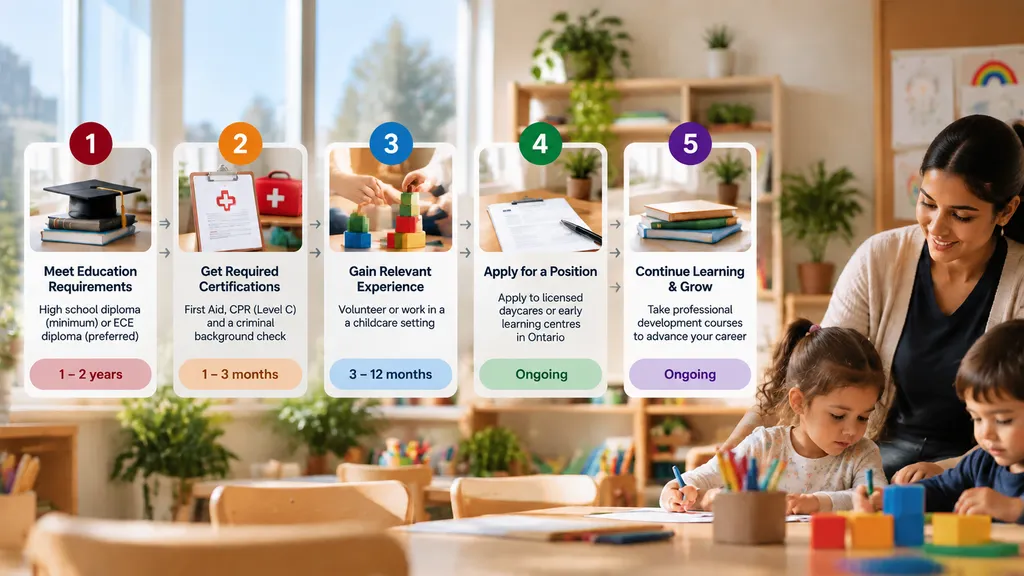
Working toward a Registered Early Childhood Educator title in Ontario follows a fixed sequence set by the regulatory body, not a menu of optional steps. In order, the requirements are:
- Complete an early childhood education diploma or equivalent from an approved education program.
- Complete the required field placement hours as part of that program, working directly with children in real child care settings.
- Apply to and register with the College of Early Childhood Educators, including a criminal reference check and a declaration of good character.
- Pay the application and registration fees and wait through the College’s standard processing window.
- Once registered, maintain your standing through the College’s Continuous Professional Learning program each year.
Each step depends on the one before it. You cannot register with the College before your program confirms completion, and you cannot list required field placement hours without enrolling in a recognized early childhood education program first. Skipping ahead, such as applying before transcripts are finalized, is one of the most common reasons an application stalls partway through review.
Each requirement explained
The five-step sequence above covers the formal path to becoming a Registered Early Childhood Educator. Below, each of the first three requirements gets a closer look, since these are the steps applicants get wrong most often. Requirements four and five (fees and ongoing learning) are covered in their own sections further down this page.
Requirement one: complete an approved early childhood education diploma
The College of Early Childhood Educators only recognizes credentials from an approved early childhood education program, which almost always means a two-year Ontario college diploma. Coursework in these programs typically covers child development, curriculum design, health and safety, and inclusive early learning environments, giving students both the theory and the observation strategies used daily in a classroom.
Students who already hold a degree in an unrelated field sometimes assume their credential transfers automatically. It does not.
The College assesses non-ECE credentials individually. Applicants without a matching diploma usually need to complete a bridging or fast track program that fills specific gaps in child development and curriculum coursework before registration becomes possible.
You can review the Early Childhood Assistant program at Central College for a look at how a Mississauga-based ECA credential structures its coursework alongside required field placement.
Coursework in an approved program goes well beyond memorizing child development stages. Ontario’s early years sector is built around a shared pedagogical approach, often introduced through the Ministry’s “How Does Learning Happen?” framework, which asks educators to co-create learning contexts with children rather than simply deliver a fixed lesson plan.
That approach shapes how students are taught to think about holistic development. Coursework covers how to support children’s learning and development across diverse abilities, building inclusive education practices into everyday routines rather than treating accommodation as an afterthought.
Programs also teach the difference between reasonable risk taking and actual neglect, a distinction that matters directly in outdoor play and physical activity. A perceived risk, like a child climbing a low structure, is not automatically a safety failure; students learn to assess actual risk using evidence informed practices rather than reacting out of caution alone.
Students also practice professional communication and reflective practice, skills used constantly when documenting a child’s progress or discussing concerns with families. Coursework touches on relevant legislation, government authorities, and agency policies that govern licensed settings, so graduates understand not just what to do with children, but why the rule exists and who set it.
Some programs also address supporting francophone identity for children in French-language or bilingual settings, part of a broader push to support equitable, identity-affirming care across Ontario’s diverse communities. The goal across all of this coursework is the same: graduates who can create a stimulating environment and offer meaningful learning opportunities for young minds, whether in an infant room, a toddler room, or a kindergarten classroom.
Where to get it
Early childhood education diplomas are offered at colleges across Ontario, including in the Mississauga and broader Greater Toronto Area. Programs vary in structure. Some run as a standard two-year diploma with placements spread across multiple semesters; others offer accelerated timelines for students who already hold related post-secondary credits. If you already hold a university degree and are unsure whether a full diploma or a shorter bridging route fits your situation better, it can help to compare this path against Is a Post-Graduate Diploma a Good Qualification before enrolling.
How long it takes
A standard early childhood education diploma runs close to two years of full-time study. Accelerated or fast track options exist at some colleges for students entering with relevant prior coursework, shortening total time to under two years in select cases. Part-time study extends the timeline well beyond two years, since field placement hours still need to be completed alongside required coursework regardless of course load.
The common rejection reason
The most common reason a College of Early Childhood Educators application stalls is incomplete or unofficial transcripts, since the College requires original documentation directly from the issuing institution rather than a student copy.
Requirement two: complete supervised field placement hours
Field placement is where classroom theory turns into practical experience. Students work under the direct supervision of a Registered Early Childhood Educator inside a real child care centre, applying observation strategies and responsive relationships they have studied in coursework to actual toddlers, preschoolers, and school age children.
Beginning field placement can feel intimidating for students who have never worked in early childhood education settings before. Most programs ease students in gradually, starting with observation before moving into hands-on activities with young learners.
Throughout placement, students learn to maintain caring, consistent routines while supervisors provide feedback on everything from how a lesson was delivered to how a student responded to a child in distress. This feedback loop is what turns required courses on paper into real competence in the room, and it is central to how programs support children’s development skills in their students before graduation.
The College’s own floor is a minimum of 40 hours of practicum, but individual programs set their own, often much higher, requirements. Field placement structures differ noticeably by institution: students at Seneca complete over 500 field placement hours across their program, Sheridan requires three mandatory field placements for ECE students, and George Brown students complete a seven-week field placement each semester.
These examples illustrate that the 40-hour College minimum is a baseline, not a realistic target. Most graduates enter the workforce with substantially more direct, hands-on experience than the regulatory floor requires.
Field placements must typically be completed in person, since the point of the requirement is direct, supervised interaction with children rather than observation from a distance. Placement sites may also require proof of vaccination, including COVID-19 vaccination, before a student can begin working inside a licensed centre, so it is worth confirming a program’s specific placement requirements before enrolling. Students who eventually want to work in supporting roles rather than as a lead Registered Early Childhood Educator, such as a daycare assistant, follow a related but distinct set of expectations; see Daycare Assistant Duties for how that role differs day to day.
Requirement three: register with the College of Early Childhood Educators
Once your diploma and field placement hours are complete, the final formal step is registering with the College of Early Childhood Educators, the regulatory body that governs the ECE profession in Ontario under the Early Childhood Educators Act, 2007. Only registered members may legally use the protected titles “early childhood educator” (ECE) or “registered early childhood educator” (RECE), and their French equivalents, when describing their profession.
The registration application asks for proof of your educational credentials, a criminal reference check, and answers to a set of questions about issues that could affect your ability to practise safely and ethically. The College reviews applications against the early childhood educators code of ethics and standards of practice before granting a Certificate of Registration. Once registered, members must meet legal and ethical standards on an ongoing basis, including participating in the College’s Continuous Professional Learning program to support continuous professional learning and lifelong learning throughout a career. International students completing their education in Canada follow the same registration process as domestic students, though they should confirm their study permit and post-graduation work eligibility separately; Study in Canada: Scholarships, Work, Why to Choose Canada covers that side of the process in more detail.
How long the whole process takes
Add together education, field placement, and registration processing, and most applicants can expect a total timeline of roughly two to two and a half years from enrollment to holding a Certificate of Registration.
| Stage | Typical Duration |
|---|---|
| Early childhood education diploma (including field placement) | Approximately 2 years (less for accelerated or fast track options) |
| Gathering transcripts and application documents | 2 to 4 weeks |
| College of Early Childhood Educators application review | 8 to 10 weeks for a complete application |
| Continuous Professional Learning (ongoing, post-registration) | Annual requirement once registered |
Students who choose an accelerated or fast track diploma option, or who enter with transferable prior coursework, can shorten the education portion of this timeline. The registration review period itself, 8 to 10 weeks, stays fixed regardless of how quickly the education portion was completed, since it depends on the College’s own processing capacity rather than the applicant’s pace.
What it costs end to end
Costs for this pathway fall into two categories: the education itself, and the fixed regulatory fees charged by the College of Early Childhood Educators. Tuition fees for a two-year Ontario college diploma vary by institution, so applicants should confirm exact program costs directly with their chosen school. The regulatory costs, by contrast, are fixed and published by the College.
| Cost Item | Amount |
|---|---|
| CECE application fee (first-time applicants) | $85 |
| CECE registration fee (effective October 1, 2024) | $175 |
| Total first-year registration cost | $260 |
| Vulnerable sector or criminal reference check | Varies by police service |
| First Aid and CPR certification (often required by employers) | Varies by provider |
| Annual CECE membership renewal | Set annually by the College |
Source: College of Early Childhood Educators — schedule of application and registration fees.
Some students weighing their options also compare this path against other caregiving-focused careers with different cost structures; for example, How Much Does the PSW Course Cost in Ontario breaks down a related but separate certification path in personal support work. Diploma tuition remains the largest single cost in the ECE pathway, well above the fixed College fees, so comparing tuition fees across programs before enrolling is worth the time it takes.
Where to qualify in Mississauga
Demand for licensed child care in Peel Region, which includes Mississauga, is exceptionally high, and waitlists for some daycare spaces in the city can run a year or more. Much of this demand connects to the Canada-Wide Early Learning and Child Care (CWELCC) program, which caps fees around $22 per day for many age groups at participating centres. In Peel Region specifically, roughly 95% of licensed child care providers already participate in fee-reduction programs tied to CWELCC, which has pushed enrollment demand well ahead of available licensed spaces.
Central College of Business & Technology, located in Mississauga, offers an Early Childhood Assistant (ECA) program — a one-year, 1,000-hour credential that trains students to work directly in licensed child care settings.
Coursework covers child development, health and safety, and early learning curriculum alongside supervised field placement in real child care centres. The ECA program is designed as a direct entry credential for students who want to work as an assistant in licensed daycare or early learning settings from the day they graduate.
The ECA credential sits within the two-tier structure: assistants work under the supervision of a registered early childhood educator (RECE). Graduates who later want to lead a room independently can continue into a full two-year ECE diploma at an approved college and apply for RECE registration through the College of Early Childhood Educators — but Central College’s own program prepares students for the assistant role, not the RECE designation.
Instructors expect skills to be reliably demonstrated during placement, not just described on a written exam. Students practice supporting healthy development and support independence in young children, while learning to promote safe routines around meals, rest, and outdoor play.
Community partners and local child care centres provide much of the practical experience built into the program. This gives students exposure to infant, toddler, and preschool programming, as well as before and after school programs and kindergarten classrooms, before they graduate.
The program also touches on career options beyond a standard licensed daycare room. Graduates can go on to work in centres for children with special needs, as resource consultants providing additional support to classrooms, or in family resource programs connected to local agencies. Related programs in health care and community services at Central College give students a sense of how these career options connect to the wider social services sector in Peel Region.
Respect for a child’s social and emotional well being runs through every part of the curriculum, reflecting the same quality early years standards used across licensed Ontario programs. You can review full details on the Early Childhood Assistant program page at Central College.
Frequently asked questions
Do you need a degree to work in a daycare in Ontario?
Not for every role. Daycare assistants and support staff can often start with a high school diploma and short-term training, working under supervision. Leading a licensed classroom as a Registered Early Childhood Educator, however, requires a completed early childhood education diploma and registration with the College of Early Childhood Educators.
How long does it take to become an ECE in Ontario?
Most students complete an early childhood education diploma in about two years, including required field placement hours. Adding the College of Early Childhood Educators’ registration review, which typically takes 8 to 10 weeks for a complete application, brings the realistic total timeline to roughly two to two and a half years from enrollment to registration.
Can I work in a daycare without ECE certification in Ontario?
Yes, in a supporting role. Licensed centres employ both Registered Early Childhood Educators and unregistered staff, such as daycare assistants, working under supervision. Ontario’s Child Care and Early Years Act sets required staff-to-child ratios that specify how many RECEs must be present, but not every staff member in a licensed room needs to hold RECE registration.
What disqualifies you from becoming an RECE in Ontario?
A criminal record does not automatically disqualify an applicant, but the College reviews each case individually against actual risk to children, rather than treating every past issue as automatic grounds for refusal. Incomplete documentation, an education program the College does not recognize as equivalent, or unresolved questions about professional conduct are more common reasons an application is delayed or refused than a single past incident on its own.
About Central College of Business & Technology
Central College of Business & Technology is a registered private career college located in Mississauga, Ontario, at 1140 Burnhamthorpe Rd W, Unit 201, specialising in early childhood education alongside business, technology, and healthcare programs. The college offers career-focused diploma and certificate programs across business, technology, healthcare, and early childhood education, combining classroom instruction with hands-on training and supervised field placement in licensed child care settings. The Early Childhood Assistant program prepares graduates for assistant roles working under a registered early childhood educator — the entry point into Ontario’s licensed child care workforce.
Contact: +1 905-566-0507 | info@central-college.ca
Service area
Central College’s Mississauga campus serves students from across the Greater Toronto Area, including Mississauga, Brampton, Oakville, Etobicoke, and Toronto. The campus location provides straightforward access to public transit and major highways, supporting students who commute for classes or travel to nearby child care centres, community resources, and child service agencies for their field placement requirements.
Next step
If you are ready to start toward a career supporting young children in Ontario, review the Early Childhood Assistant program at Central College of Business & Technology to see admission requirements, course structure, and field placement details for the Mississauga campus.