
Improving your network security skills starts with strong networking fundamentals, practical security knowledge, and consistent hands-on practice. It helps cybersecurity students understand networks, identify threats, use security tools, and respond to incidents and making them job ready.
Key Takeaways
- Build strong computer networking fundamentals before advanced security topics.
- Learn how IP addresses, protocols, routing, and network traffic work.
- Understand firewalls, VPNs, access controls, and security protocols.
- Learn how intrusion detection and prevention systems work.
- Develop skills in network monitoring, vulnerability management, and incident response.
- Understand cloud computing and modern cloud security concepts.
- Practice with Linux, Windows, security tools, and network analysis.
- Develop communication, documentation, and problem-solving skills.
- Use recognized frameworks such as NIST and the NICE Framework.
- Build practical projects that demonstrate your technical abilities.

What Are Network Security Skills?
Network security skills combine technical knowledge with practical abilities used to protect networks, systems, applications, and sensitive data. These skills help professionals prevent unauthorized access, identify cyber threats, investigate suspicious activity, and support business continuity.
A strong foundation includes computer networking, operating systems, access management, security controls, threat detection, and incident response. More advanced knowledge can include cloud environments, network segmentation, vulnerability management, and security information and event management.
The goal is not to memorize security terms. It is to understand how systems work and how security controls protect them.
Start With Computer Networking Fundamentals
Deep knowledge of computer networking is essential for anyone pursuing network security. You cannot effectively protect a network without understanding how it communicates.
Start with IP addresses, ports, protocols, routing, switching, DNS, and network architecture. Learn how devices communicate across local and wide-area networks.
You should also understand inbound and outbound traffic. Learn how packets move between devices and how network administrators monitor that activity.
These fundamentals make later security concepts easier to understand.
Learn How Network Traffic Works
Network traffic analysis is a core technical skill. Security professionals need to recognize normal activity before they can identify suspicious behaviour.
Practice reading traffic patterns and understanding common protocols. Learn what legitimate communication looks like across different network environments.
Then study unusual connections, unexpected destinations, excessive traffic, and other indicators that may require investigation. Network analysis becomes more useful when you understand the systems generating the traffic.
Understand Security Principles
Before learning specific security tools, understand fundamental security principles. The CIA triad provides a useful foundation.
Confidentiality protects information from unauthorized access. Integrity protects information from unauthorized modification. Availability helps ensure systems and information remain accessible when needed.
You should also understand authentication, authorization, accountability, and the principle of least privilege. These concepts appear throughout network security and access management.

Learn Security Standards and Frameworks
Industry frameworks provide structured ways to understand cybersecurity work and risk. The NIST Cybersecurity Framework 2.0 helps organizations manage cybersecurity risk through a common structure and outcomes. (NIST)
You should also become familiar with ISO/IEC 27001. It defines requirements for an information security management system and supports organizational risk management. (ISO)
These frameworks are not substitutes for technical skills. They help you understand how technical security supports broader organizational objectives.
Develop Intrusion Detection Skills
An intrusion detection system monitors activity and generates alerts when it identifies potentially malicious behaviour.
You should understand both network-based and host-based intrusion detection. Learn how security teams use alerts to investigate potential threats.
Signature-based detection looks for known patterns. Anomaly based detection looks for activity that differs from expected behaviour.
Understanding both approaches helps you recognize how modern threat detection works.
Understand the Intrusion Prevention System
An intrusion prevention system goes beyond detection. It can actively block or prevent certain malicious network activity.
Learn how an intrusion prevention system evaluates traffic and applies security rules. Understand how false positives can affect operations and why security teams must tune prevention systems carefully.
You should also understand the relationship between an intrusion detection system and an intrusion prevention system. Detection alerts security teams, while prevention can take action against identified threats.
Master Intrusion Detection and Prevention
Intrusion detection and prevention requires more than knowing what IDS and IPS stand for. You need to understand how these systems fit into an organization’s wider security architecture.
Study alert generation, traffic inspection, signatures, anomaly detection, logging, and response workflows.
Then practice interpreting alerts. Ask what happened, which asset was affected, whether the activity was authorized, and what action should follow.
That investigative mindset is essential for security professionals.
Learn Firewalls and Access Controls
Firewalls remain an important security control for filtering network traffic. They can enforce rules governing which connections are allowed or blocked.
Learn how rules use addresses, ports, protocols, applications, and other conditions. Understand why poorly designed rules can create unnecessary exposure.
You should also learn access management. Access controls determine which authorized users can reach systems, applications, or resources.
Understand VPNs and Secure Access
Virtual private networks create encrypted connections for secure communication across untrusted networks.
Learn why encryption protects data during transmission. Understand authentication, tunnelling, encryption protocols, and remote-access controls.
VPN knowledge is particularly relevant when organizations support remote users and distributed workforces. However, VPNs are only one component of secure access architecture.
Learn Multi-Factor Authentication
Passwords alone are not sufficient for many modern environments. Multi-factor authentication adds another authentication factor before access is granted.
Learn the difference between knowledge, possession, and inherence factors. Understand why strong authentication reduces the impact of compromised credentials.
You should also understand authorization after authentication. Proving someone’s identity does not automatically mean they should access every resource.
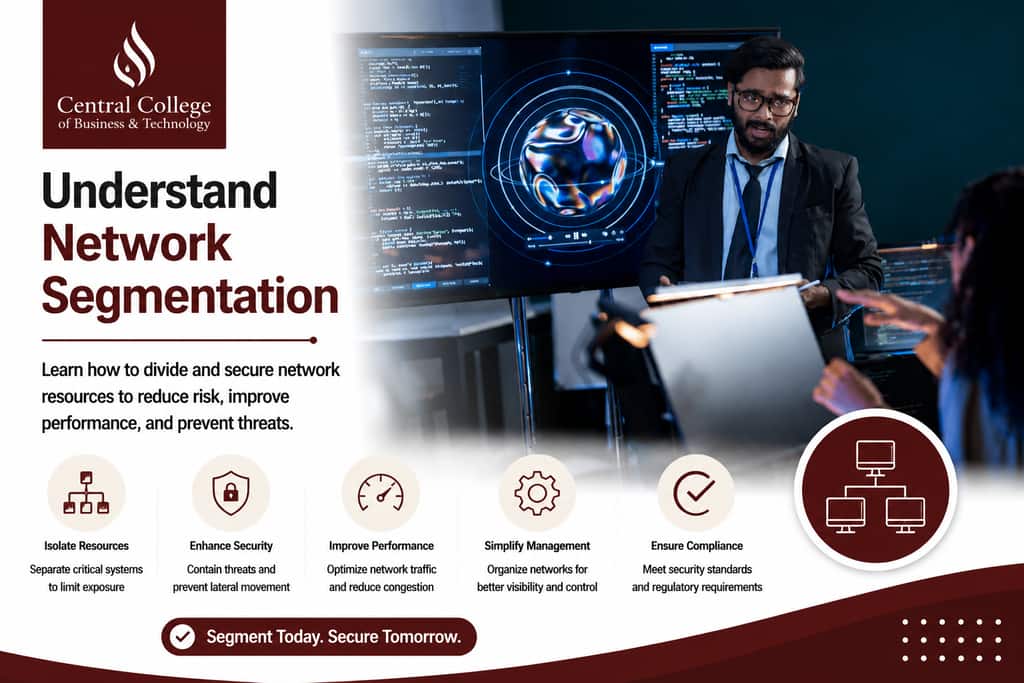
Understand Network Segmentation
Network segmentation divides networks into separate sections. This can help limit access and reduce the spread of security incidents.
Learn how segmentation can separate users, servers, applications, and critical infrastructure. Understand how security policies can differ between segments.
Segmentation also supports access control. Users should receive access based on their responsibilities rather than broad network visibility.
Learn Wireless Network Security
Wireless networks create additional security considerations. You should understand authentication, encryption, access points, and wireless security configurations.
Learn how security professionals identify rogue access points and unauthorized connections. Understand how weak configurations can expose networks to unauthorized access.
Wireless security should be treated as part of the wider network architecture rather than as an isolated topic.
Build Linux and Windows Skills
Network security professionals frequently work across different operating systems. Develop practical familiarity with both Linux and Windows environments.
Learn user accounts, permissions, services, logs, processes, networking commands, and system configuration.
You should also understand basic systems administration. This knowledge helps you identify abnormal activity and communicate effectively with network administrators.
Learn Security Tools
Theory becomes more valuable when you can apply it. Develop hands-on familiarity with foundational security tools used for network analysis, vulnerability assessment, monitoring, and incident investigation.
Learn what each tool does rather than simply memorizing commands. Understand what information the tool produces and how that information supports a security decision.
Tools can change. The underlying concepts remain more durable.
Develop Vulnerability Management Skills
Vulnerability management involves identifying weaknesses, assessing their significance, and supporting remediation.
Learn how vulnerability scanners work and understand the difference between identifying a vulnerability and exploiting one.
Knowing how attackers operate can help professionals conduct meaningful vulnerability assessments. However, testing should always occur within authorized environments.
A strong learner understands both the technical weakness and its potential business impact.
Learn Network Monitoring and Event Management
Monitoring helps security teams understand what happens across computer systems and networks. Logs can reveal authentication events, unusual connections, configuration changes, and other indicators.
Event management involves collecting, organizing, and analyzing security information from multiple sources.
Learn how to investigate events instead of treating every alert as equally important. Prioritization is essential when security teams face large volumes of activity.
Develop Incident Response Skills
Incident response is the process of handling suspected or confirmed security incidents. It requires technical judgment, documentation, communication, and structured decision-making.
Learn the basic stages of preparation, detection, analysis, containment, eradication, recovery, and lessons learned.
You should practice asking practical questions. What happened? Which systems are affected? Is the threat still active? What evidence needs preservation?
Incident response depends heavily on critical thinking.
Learn Data Loss Prevention
Data loss prevention focuses on protecting sensitive information from inappropriate disclosure, transfer, or loss.
Understand how organizations identify sensitive data and apply controls around its movement. Learn how policies can restrict or monitor data leaving an environment.
This knowledge connects network security with privacy, compliance, data management, and business operations.
Understand Email Security
Email remains an important security area because attackers can use messages to deliver phishing attempts, malicious files, and fraudulent requests.
Learn how email security controls identify suspicious messages. Understand authentication mechanisms, filtering, malicious attachments, and phishing indicators.
Security awareness also matters. Technical controls work better when users understand how to recognize suspicious communication.
Learn Cloud Computing and Cloud Security
Modern networks increasingly connect with cloud resources. That makes cloud computing knowledge increasingly important for network security professionals.
Learn cloud networking, identity management, virtual networks, storage permissions, logging, and cloud security controls.
Understand that cloud security responsibilities are shared between providers and customers. Your role depends on the service model and environment.
Cloud environments also require strong authentication and authorization.
Understand Zero Trust
Zero trust changes how organizations approach access. Instead of assuming that users or devices are trusted because they are inside a network, access decisions are based on identity, policy, device context, and other factors.
Learn the principles of continuous verification and least privilege. Zero trust also depends heavily on strong authentication and authorization.
These concepts are increasingly relevant to modern network architectures.
Build Basic Programming and Scripting Skills
You do not need to become a software developer to work in network security. However, basic programming knowledge can improve efficiency.
Python is particularly useful for automation, data processing, log analysis, and repetitive security tasks.
Start with variables, conditions, loops, functions, files, and basic APIs. Then build small scripts that solve practical problems.
Automation should support security work rather than replace sound judgment.
Improve Communication and Documentation
Technical knowledge alone does not make someone job-ready. Security professionals must explain risks to people with different technical backgrounds.
Practice writing concise incident summaries and documenting investigations. Learn how to explain what happened, why it matters, and what should happen next.
Teamwork also matters. Security operations involve administrators, developers, managers, compliance teams, and other stakeholders.
Strong communication can make technical expertise much more useful.
Practice With Realistic Labs
Hands-on practice is where knowledge becomes a skill. Build an isolated lab using virtual machines and authorized tools.
Create simple scenarios involving firewalls, access controls, VPNs, logs, suspicious traffic, and intrusion detection.
Practice identifying a problem and documenting your response. Keep notes about the tools used, evidence found, decisions made, and lessons learned.
Do not test systems that you do not own or have explicit permission to assess.
Build Projects for Your Portfolio
A portfolio can demonstrate practical ability better than a list of technical terms. Create projects that show how you applied your knowledge.
For example, you could document a segmented lab network, analyze sample traffic, configure access controls, investigate simulated alerts, or create a basic monitoring workflow.
Each project should explain the objective, environment, tools, process, findings, and security improvements.
That structure demonstrates technical reasoning.
Follow the NICE Framework
The NICE Framework provides a common language for describing cybersecurity work, including tasks, knowledge, and skills. NIST describes it as a resource for learners, job seekers, employers, educators, and workforce development. (NIST Computer Security Resource Center)
Use it to understand how your skills connect with cybersecurity work roles. Instead of asking only, “What tool should I learn?” ask, “What tasks must someone perform in this role?”
That approach creates a more focused learning plan.
Build a Beginner-to-Job-Ready Roadmap
A practical progression can look like this:
Stage 1 — Networking: Learn IP addressing, protocols, routing, switching, DNS, and traffic.
Stage 2 — Systems: Build Linux and Windows administration skills.
Stage 3 — Security: Study authentication, authorization, firewalls, VPNs, encryption, and security controls.
Stage 4 — Detection: Learn IDS, IPS, monitoring, logs, event management, and anomaly detection.
Stage 5 — Response: Practice incident response, vulnerability management, and documentation.
Stage 6 — Cloud: Study cloud computing, identity, cloud networking, and cloud security.
Stage 7 — Practice: Build labs and complete security projects.
Stage 8 — Career preparation: Align your skills with relevant job descriptions and cybersecurity work roles.
This progression gives you a logical foundation before moving into specialized areas.
How Do You Know You Are Job-Ready?
Being job-ready does not mean knowing every security technology. Cybersecurity is too broad for that.
You should instead be able to explain networking fundamentals, identify common threats, analyze basic network activity, configure security controls, investigate alerts, and document findings.
You should also know your limits. Good security professionals know when to escalate an issue and when additional expertise is required.
Continuous learning remains essential because the threat landscape changes frequently.

Certifications and Network Security Skills
Certifications can complement practical training, but they should not replace hands-on experience.
Choose certifications that match your target role and current skill level. Before paying for an exam, review its objectives and compare them with your existing knowledge.
A useful approach is to combine certification preparation with labs and projects. That allows you to understand concepts instead of simply memorizing exam questions.
Why Choose Central College of Business & Technology?
Central College of Business & Technology in Mississauga offers a Cybersecurity Analyst Program that combines theory with field practicum. Its published program structure lists 1,000 total hours, including 484 theory hours and 516 field practicum hours. (Central College)
The program covers areas including network administration, Linux fundamentals, cloud environments, IT project management, and cybersecurity concepts. Its published curriculum also includes information systems and network security, wireless networks, operating systems, cloud environments, digital forensics, and incident response. (Central College)
Central College also offers a Post-Graduate Diploma in Network & Cloud Systems Engineering. Its published curriculum includes VPNs, encryption, authentication and authorization, firewalls, security monitoring, vulnerability scanning, prevention system management, cloud infrastructure, and cloud security. (Central College)
This makes the college relevant for learners who want to develop both network security skills and broader systems or cloud capabilities.
FAQs
What network security skills should beginners learn first?
Beginners should start with computer networking before moving into advanced security concepts. Learn IP addresses, protocols, routing, DNS, network traffic, operating systems, authentication, and access controls. Then progress toward firewalls, VPNs, intrusion detection, vulnerability management, and incident response. Strong fundamentals make it easier to understand why security controls work and where they can fail.
What is the difference between an intrusion detection system and an intrusion prevention system?
An intrusion detection system identifies potentially suspicious activity and generates alerts for investigation. An intrusion prevention system can take active action by blocking or preventing certain malicious traffic. Both technologies can contribute to intrusion detection and prevention, but they serve different functions. Learning how alerts, signatures, anomaly detection, and prevention rules work is important for security operations.
Why are event management and incident response important?
Event management helps security teams collect and analyze information from systems, devices, and applications. It can reveal unusual activity that requires investigation. Incident response then provides a structured process for analyzing and containing security incidents. These skills help professionals move from simply seeing an alert to understanding what happened, determining its impact, preserving evidence, and supporting recovery.
Why are cloud computing and data loss prevention important?
Cloud computing introduces new security considerations involving identities, permissions, networks, workloads, and cloud resources. Data loss prevention focuses on protecting sensitive information from inappropriate disclosure or transfer. Together, these areas help security professionals address risks across modern environments. Understanding cloud architecture and information protection also makes it easier to work with security teams supporting distributed infrastructure.
How can I practice network security skills safely?
Use an isolated, authorized laboratory environment. Virtual machines can help you create controlled networks where you can practice configuration, monitoring, vulnerability assessment, and incident response. Never scan, exploit, or interfere with networks without permission. Document each exercise and explain what you observed. A portfolio of authorized projects can demonstrate practical skills to potential employers.
Final Thoughts
Improving your network security skills is a progression, not a single course or certification. Start with networking fundamentals, then develop security knowledge through structured practice.
Learn how firewalls, VPNs, access controls, IDS, IPS, monitoring, and segmentation work. Add Linux, Windows, cloud computing, vulnerability management, and incident response. Then strengthen your communication and documentation skills.
Most importantly, keep practicing. The NICE Framework itself organizes cybersecurity work around tasks, knowledge, and skills, reinforcing the importance of competency rather than tool memorization. (NIST)
If you are ready to move from foundational knowledge toward practical cybersecurity training, explore Central College of Business & Technology’s cybersecurity and network-focused programs. Its combination of classroom learning and practical training can provide a structured starting point for developing the skills required in modern security environments. (Central College)